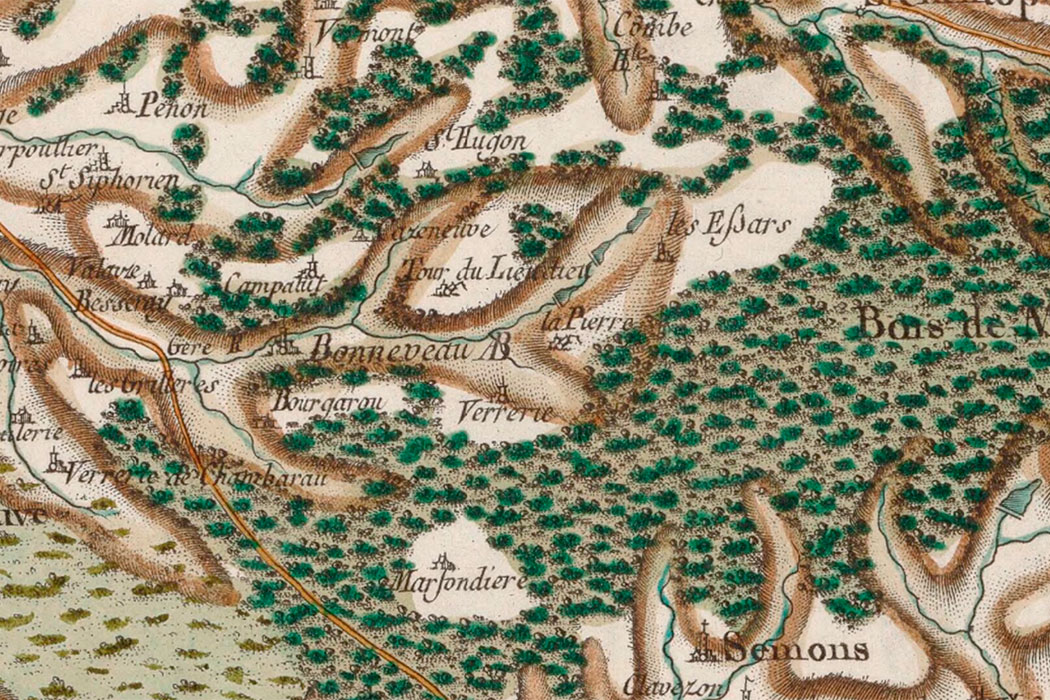
Detail of Carte générale de la France
Cassini de Thury (18th century)
Bibliothèque nationale de France

The Cistercian Abbey of Notre-Dame de Bonnevaux was founded in 1119 thanks to the initiative of Guy of Burgundy (c. 1060-1124), Archbishop of Vienne (1088-1119) and later pope (Callixtus II, 1119-1124). From 1117 onwards, he had negotiated the arrival of the Cistercians in his diocese with Stephen Harding, abbot of Cîteaux (Côte-d’Or). The first abbot of this house was Jean (1117-1141), later Bishop of Valence (1141-1146) and venerated as a saint. Another monk of the monastery was also canonised: Peter II of Tarentaise (1102-1174), who served as abbot of Tamié (Savoie) before becoming Archbishop of Tarentaise.
Affiliation of Bonnevaux
According to Originum Cisterciensium (L. Janauschek, 1877)Abbey of Bonnevaux / 1119
Abbey of Mazan (Ardèche) / 1120
Abbey of Montpeyroux (Puy-de-Dôme) / 1126
Abbey of Tamié (Savoie) / 1134
Abbey of Léoncel (Drôme) / 1137
Abbey of Valmagne (Hérault) / 1155
Abbey of Sylveréal (Gard) / 1173
Abbey of Valbenoîte (Loire) / 1184
Abbey of Valcroissant (Drôme) / 1188
The abbey soon became a prosperous monastery, enabling it to found several daughter abbeys: the first was Mazan (Ardèche), followed by Tamié (Savoie) and Valmagne (Hérault), among others. During this period of expansion, the abbot of Bonnevaux exercised notable influence within the Cistercian Order. However, in the second half of the thirteenth century, Abbot Adam was deposed because of negligence in the internal governance of the house. In 1576 Bonnevaux was occupied by Calvinist forces; the monastery was plundered and burned, and many of its possessions, including its archive, were lost.
Despite attempts at reconstruction, the abbey never regained its former standing. Records indicate that in 1710 many buildings were still in ruins, including the church itself. By 1740 the community had been reduced to five monks. During the Revolution the monastery disappeared entirely: the stone from its ruins was reused in other constructions and no visible remains survive today. Only archaeological investigations have provided some information about its structures.
- BAUDRILLART, Alfred (1937). Dictionnaire d'histoire et de géographie ecclésiastiques. Vol. 9. París: Letouzey et Ané
- BESSE, J.-M.; i altres (1939). Abbayes et prieurés de l'ancienne France. Vol. 9: Province ecclésiastique de Vienne. Abbaye de Ligugé
- CHEVALIER, Ulysse (1889). Cartulaire de l'abbaye N.-D. de Bonnevaux, au diocèse de Vienne. Grenoble: Allier
- GOUHIER, Bastien (2021). Abbaye de Bonnevaux. Rapport d'intervention
- JANAUSCHEK, Leopoldus (1877). Originum Cisterciensium. Vol. 1. Viena
- SAINT-MAUR, Congregació de (1865). Gallia Christiana in provincias ecclesiasticas distributa. Vol. 16. París: Firmin Didot
The monastery, now virtually lost, was located in the commune of Villeneuve-de-Marc (Isère), on the banks of the river Gère